
Managing artist and fan accounts across music platforms without spreading your number

An independent artist today runs more accounts than a small label did twenty years ago. There is a distributor, artist profiles on several streaming services, social pages, a fan newsletter, a merch store, collaboration tools and, more and more often, a royalty or fan-investment platform. For the tools you are only testing, an smsfast temporary number can receive the sign-up code, so your personal number does not end up in every music app you try once. The accounts that pay you are a different story, and this guide shows where to draw the line.
Why music careers now run on dozens of accounts
Streaming has become the backbone of the business. According to IFPI’s Global Music Report 2025, published on March 19, 2025, global recorded music revenues grew 4.8% in 2024 to $29.6 billion. Streaming made up 69% of that total, and paid subscription users reached 752 million.
Every new revenue stream brings a new dashboard. Artists claim profiles on each streaming service, connect a distributor, open fan platforms and test promotion tools. Most of these services verify a phone number at sign-up, and many keep using it for login codes, payout confirmations and marketing calls.
Accounts that pay you vs accounts that help you
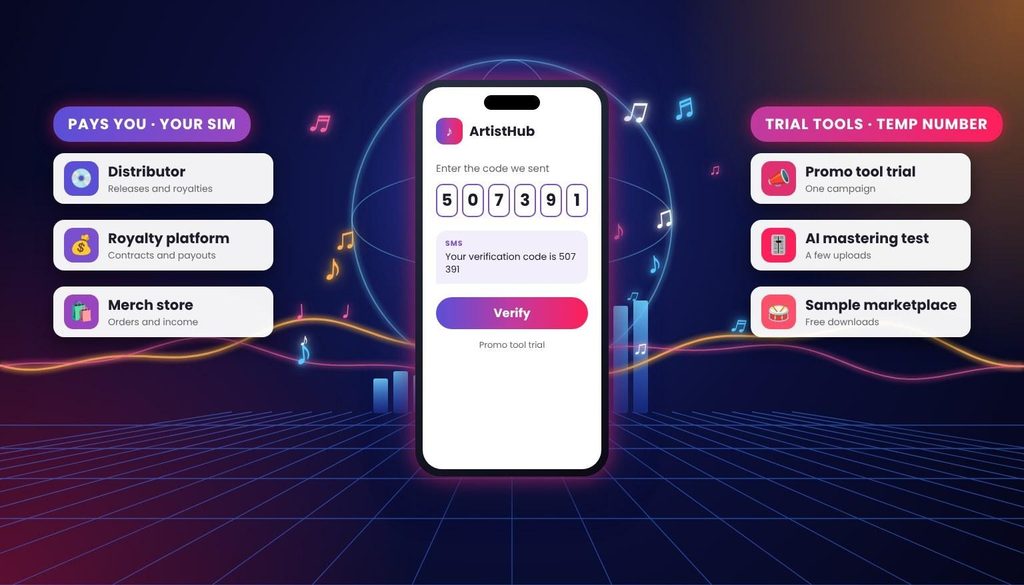
The quickest way to decide which number to use is to ask whether the account moves money or controls your releases. If it does, it needs a contact you will own for years. If it only helps you create, promote or learn, it can live on a separate number.
| Account type | What it controls | Which number |
| Music distributor | Releases, royalties, payout method | Your own SIM number |
| Royalty or fan-investment platform | Contracts, earnings, tax details | Your own SIM number |
| Merch or ticketing store with payouts | Orders and income | Your own SIM number |
| Shared band or project account | Social pages, streaming profile access | Long-term rented number |
| Promotion or playlist pitching tool on trial | A campaign and a dashboard | Temporary number |
| Mastering, beat or sample marketplace you are testing | A few downloads or uploads | Temporary number |
| Fan community or newsletter tool you are comparing | A trial list and settings | Temporary number |
If an account can lose you a royalty payment or a release, its number must stay under your control. Everything you are only evaluating can stay outside your personal contact list.
Band and project accounts need a shared contact
Bands and duos often register their social pages and profiles with one member’s personal phone. That works until the member leaves, changes numbers or simply cannot be reached when a login code arrives. Then the whole project can lose access to its own page.
A long-term rented number solves that problem. It belongs to the project rather than to one person, and it can stay the same while the line-up changes. Typical project accounts that benefit from a shared number include:
- the band’s social media pages and messaging inbox;
- a shared email address for bookings and press;
- collaboration and file-sharing tools used by the whole group;
- streaming profile access for a manager or new member.
Record who manages the rental and when it renews, so the project never loses a code because a subscription quietly expired.
Testing music tools without spreading your number
New promotion services, AI mastering tools and sample marketplaces appear every month. Use the same short routine for each one.
1. Read the tool’s terms and check whether it touches your releases or payouts.
2. If it does not, sign up with a separate email and a temporary number.
3. Test the free tier or trial and note what it actually did for your music.
4. Keep it only if it earned a place, then move the account to a long-term number.
5. Delete the account and its data if it did not.
Services such as SMSFAST offer numbers in 190+ countries for more than 500 platforms, with short activations of 20 to 90 minutes and rentals from one day to one year.
What stays on your real number
Some music accounts are financial accounts in disguise. Distributors and royalty platforms hold your bank details, tax forms and contracts, and they send payout confirmations by SMS. Never register these with a temporary number, because an expired number can lock you out exactly when a payment needs approval.
The same goes for any platform where you invest in music rights or receive income from fans. Use your own SIM, add an authenticator app where the service supports it, and keep backup codes offline. If you work with a manager or label, agree in writing whose number sits on each payout account, so access never depends on one person’s phone.
Honest limits
Some streaming services, ticketing sites and social networks detect virtual numbers and ask for a carrier number. That is the platform asking for a stable contact, so decide whether the account is worth your real number. Temporary numbers also expire within minutes to hours, which suits a quick test but not a profile you will manage for years. Rules on accepted numbers change often, so check a service’s help page before you sign up.
Fan accounts follow the same logic. Ticket presales and limited drops usually allow one account per fan. Use a separate number for privacy, not to multiply entries or get around those limits.
The bottom line
A music career now lives across many platforms, and each one asks for a phone. Keep distributors, royalty platforms and payout stores on your own number, give shared band accounts a long-term rented one, and test new tools with a temporary number. Your personal phone stays private, and your income stays tied to a contact you control.
